 admin
admin 1. Introduction
A smart wealth management system is essential for anyone who wants automated tracking and long-term financial planning.For years, spreadsheets have served as the default tool for tracking assets, liabilities, and financial documents. But today’s wealth landscape is far more complex than a set of rows and columns can realistically support. Families and individuals now manage diverse portfolios-multiple bank accounts, insurance policies, real estate, digital assets, loans, long-term investments, and essential documents that require ongoing updates. As financial structures expand, spreadsheets become increasingly fragile, error-prone, and inefficient for maintaining long-term visibility.
The core limitation lies in how spreadsheets treat data: static, manually updated, and vulnerable to human error. Studies consistently show that manual financial workflows introduce error rates ranging from simple numerical mistakes to mislinked formulas that distort valuations. This is where a smart wealth management system becomes crucial, replacing scattered files with structured, automated updates. Each additional asset or policy increases the operational load, making it harder to maintain consistency, version control, and accuracy across multiple files and devices. Over time, this fragmented setup weakens financial clarity-especially when decisions rely on outdated or incomplete information.
Beyond accuracy challenges, spreadsheets create structural risks that grow more severe as wealth complexity increases-risks that a smart wealth management system can easily prevent. They lack audit trails, secure permissions, automated reminders, and real-time updates. A single overwritten cell, lost file, or misnamed folder can derail months of financial organization. And for families who rely on shared visibility, spreadsheet-driven workflows often break down due to inconsistent versions and unaligned updates.
These vulnerabilities matter because modern wealth management requires more than storage-it requires continuity, structure, and proactive oversight. A smart wealth management system addresses these gaps by offering organized asset categorization, automated document tracking, and secure access controls that spreadsheets simply weren’t built to deliver.
Common spreadsheet-related risks include:
- Manual errors that compound over time
- Multiple conflicting versions stored across devices
- Limited or no security for sensitive financial data
In a world where wealth records must be accurate, accessible, and strategically managed, spreadsheets no longer provide the reliability or structure needed for long-term financial control.
2. The Hidden Cost of Managing Wealth Records on Spreadsheets
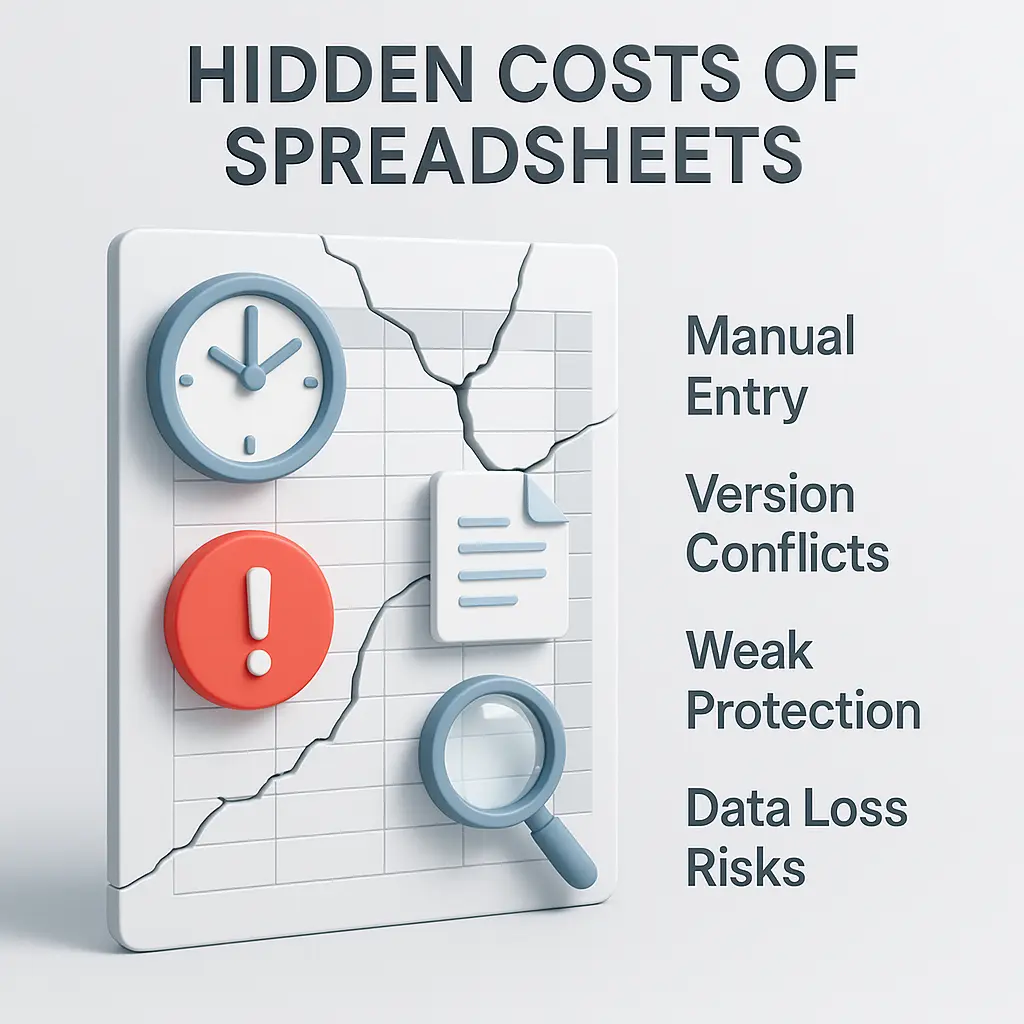
Spreadsheets may appear inexpensive on the surface, but the operational burden they create often outweighs their convenience. As wealth portfolios expand, the time spent managing fragmented files, updating formulas, and cross-checking entries becomes a silent but persistent drain on productivity. What seems like a simple tool quickly turns into an administrative system that demands constant maintenance.
The most significant hidden cost is manual data entry. Every update-whether it’s a new investment, a changed policy premium, or a revised property valuation-requires human intervention. This introduces inevitable inconsistencies that undermine financial data organization, especially when records are copied across multiple sheets or devices. Research shows that even small manual entry errors can compound into major inaccuracies, affecting everything from tax planning to long-term projections.
Outdated or incomplete information is another major risk. Spreadsheets rely entirely on the user to refresh values, attach documents, and maintain version control. When updates are missed, the entire financial picture becomes unreliable. For families managing multiple assets, this lag leads to delayed decisions, miscalculations, and limited oversight during critical financial moments.
Spreadsheets also fall short during audits or financial reviews. They lack structured data models, consistent formatting, and automated logs that show who changed what and when. This makes it difficult to validate numbers, track historical valuations, or offer advisors a clear audit trail. The time spent reconciling files, hunting for backups, or resolving mismatched figures often exceeds the time spent analyzing actual performance.
A smart wealth management system helps eliminate these hidden costs by automating updates, centralizing information, and ensuring error-free wealth tracking-capabilities that static spreadsheets cannot match.
Key hidden costs of spreadsheet-based wealth tracking include:
- Significant time spent on manual updates and reconciliations
- Frequent errors caused by broken formulas or overwritten entries
- Outdated records that impair accurate financial planning
In reality, spreadsheets don’t just slow wealth management-they obscure clarity, increase operational risk, and reduce the accuracy needed for confident financial decision-making.
3. What Modern Wealth-Record Management Should Look Like
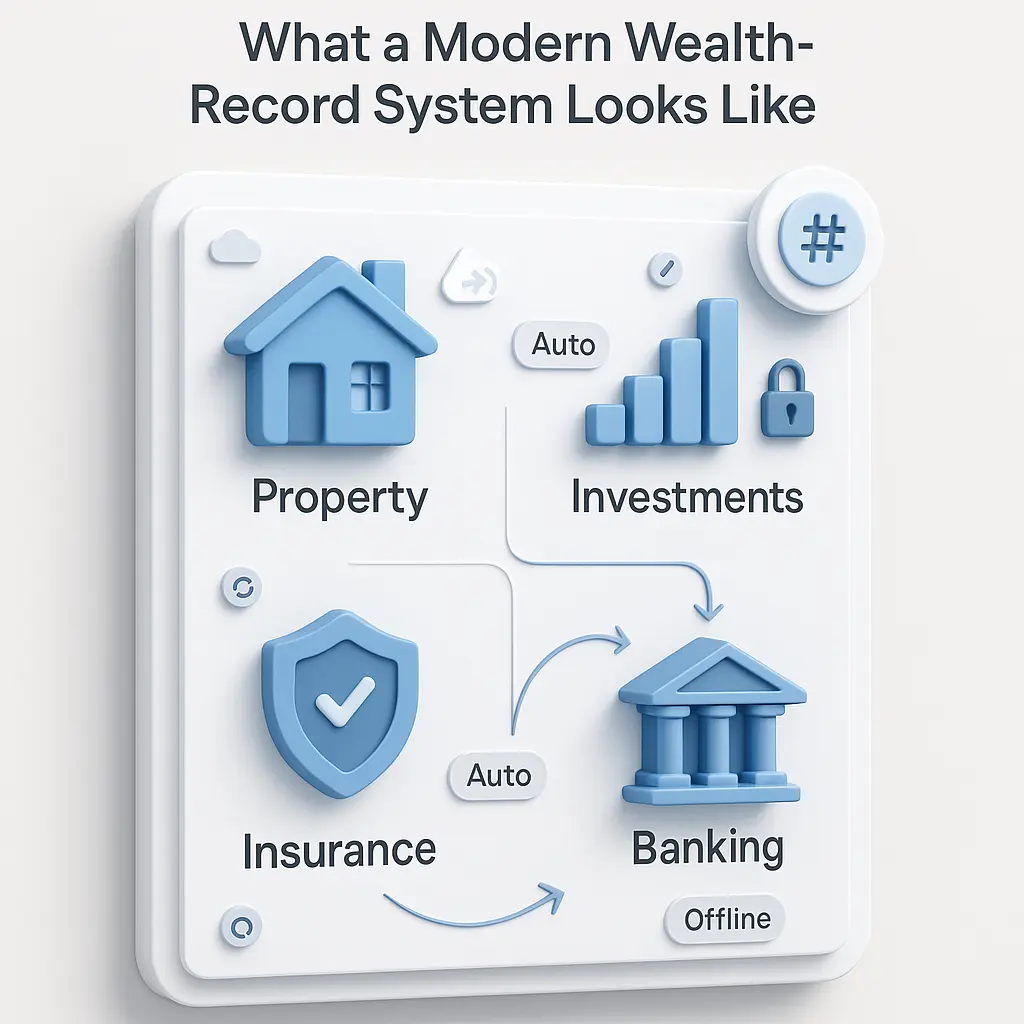
Modern wealth-record management goes far beyond storing information-it must provide precision, structure, and real-time clarity. As financial portfolios become more diverse, individuals and families require systems that streamline updates, reduce manual work, and bring transparency to every aspect of their financial landscape. A truly smart wealth management system delivers this by combining accuracy, automation, structured data models, and seamless accessibility into one unified experience.
At its core, modern wealth-record management prioritizes accuracy. Every valuation, document, and entry must be consistently maintained without the risk of overwritten cells or fragmented files. Automation amplifies this accuracy by eliminating routine data entry, ensuring that recurring updates-such as premium renewals, loan EMIs, or investment contributions-are tracked without manual effort.
Structured data is another essential pillar. Instead of scattered tabs or inconsistent formatting, modern systems categorize assets, liabilities, documents, and financial notes in a way that supports quick retrieval and long-term organization. This structure also enables audit-ready records, historical views, and better data governance-capabilities spreadsheets cannot replicate.
Accessibility completes the modern framework. Wealth information should be available across devices, backed by secure authentication, encrypted storage, and intuitive navigation. Users should be able to retrieve any document or valuation instantly, without searching through folders or validating outdated formulas.
Key pillars of modern wealth-record management include:
- Accurate, real-time data with minimal manual work
- Automation that ensures timely updates and reminders
- Structured financial categorization for clarity and governance
- Secure, seamless access on any device
Example Framework: Traditional Spreadsheets vs. Modern Wealth-Record Systems
| Capability | Spreadsheets | Modern Wealth-Record System |
|---|---|---|
| Data Accuracy | Manual, error-prone | Automated, consistent, audit-ready |
| Structure & Categorization | User-dependent formatting | Predefined, organized data models |
| Document Management | Stored separately, hard to track | Integrated, linked, instantly retrievable |
| Accessibility | Limited device-based access | Secure, multi-device access with authentication |
| Automation | None | Alerts, reminders, and automated updates |
| Version Control | Multiple conflicting files | Centralized, governed, and synchronized |
Modern wealth-record management isn’t just about storing financial information-it’s about organizing it intelligently, reducing operational friction, and enabling long-term financial clarity through structured, technology-driven design.
4. Security Risks: Why Spreadsheets Fail at Protecting Sensitive Wealth Data
Spreadsheets were never designed to safeguard highly sensitive financial information. As wealth portfolios grow more complex, the security shortcomings of traditional files become increasingly visible-issues a smart wealth management system is built to address. Unlike dedicated financial platforms, spreadsheets rely on basic password protection, manual sharing, and unsecured storage locations-creating significant vulnerabilities for anyone managing personal or family wealth records.
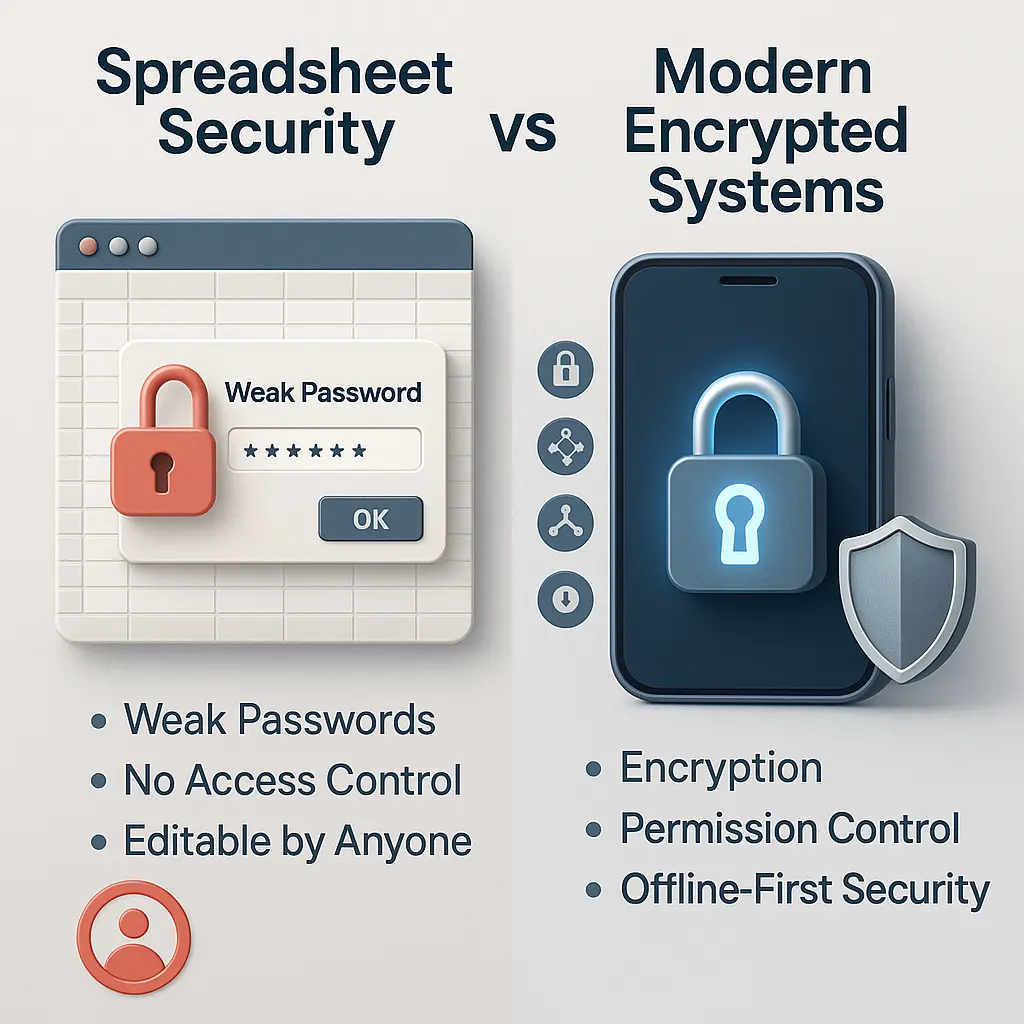
The first major weakness is permission control. Spreadsheets offer minimal governance over who can view, edit, or download data. Once a file is shared, visibility is essentially unrestricted, making it difficult to enforce confidentiality or limit access to specific financial categories. This lack of granular permissions exposes users to unauthorized edits, accidental deletions, and data misuse.
Password protection offers little comfort. Spreadsheet passwords are not true encryption; they can be removed or bypassed with widely available tools. Even when protected, files stored on unencrypted devices or shared via email remain exposed to interception, copying, or unintended access. Without strong encryption or audit logs, there is no reliable way to track who accessed sensitive wealth information-or when.
Version conflicts create another security threat. Each time a spreadsheet is emailed, downloaded, or saved under a new filename, multiple uncontrolled copies circulate across devices. This increases the risk of outdated information being referenced, sensitive files being misplaced, and unauthorized users gaining access to older versions. From a compliance standpoint, such fragmented data trails pose significant challenges.
Regulatory expectations around data privacy have also risen, especially for financial documentation. Storing wealth records in unsecured spreadsheets can violate emerging standards for confidentiality, retention, and auditability. These gaps highlight why transitioning to a smart wealth management system with built-in encryption, structured access, and automated protection measures is becoming essential.
Key security risks of spreadsheet-based wealth storage include:
- Weak or easily bypassed password protection
- No detailed permission control or activity tracking
- Multiple uncontrolled versions across devices
- Exposure to data leaks, accidental sharing, and non-compliant storage
In an environment where financial data privacy is critical, spreadsheets simply cannot deliver the level of protection required to manage sensitive wealth information securely.
5. The Business Impact of Upgrading to a Modern Wealth-Record System
Upgrading from spreadsheets to a modern wealth-record platform is not just a technological improvement-it is a business decision that directly influences productivity, cost efficiency, and long-term financial clarity. When wealth information is centralised, automated, and structured, families and decision-makers benefit from faster workflows, fewer manual tasks, and significantly reduced error rates. A smart wealth management system delivers these advantages by transforming fragmented processes into a streamlined, reliable financial operating model.
The most immediate impact is productivity. Manual data entry, duplicate record checks, and version reconciliation consume considerable time, especially for households or family offices managing multiple assets. Modern systems automate routine updates, link supporting documents, and offer real-time visibility, enabling users to retrieve information in seconds rather than hours. This reduction in administrative load translates directly into time savings and improved operational focus.
Cost savings follow naturally. Errors in spreadsheets often lead to miscalculations, missed renewals, and overlooked obligations-each carrying financial consequences. A structured digital system minimizes these risks, improving the accuracy of valuations, policy tracking, and long-term planning. Reduced reliance on external support for document organization or audit preparation also lowers recurring operational expenses.
A modern approach also strengthens collaboration. Financial advisors, accountants, legal partners, and family members often require access to the same information. Instead of circulating multiple spreadsheet versions, a centralized digital platform provides permission-based visibility, ensuring that every stakeholder works from a unified, updated dataset. This creates clarity, reduces communication gaps, and accelerates decision-making cycles.
When evaluated as a whole, the transition to a smart wealth management system supports better governance, more confident financial decisions, and long-term resilience.
Key business outcomes include:
- Significant time savings through automation and centralized access
- Lower financial risk due to accurate, real-time data
- Improved collaboration across advisors, partners, and family members
- Reduced operational cost from fewer errors and redundant tasks
Modern wealth-record systems aren’t just more efficient-they deliver tangible business value by replacing manual, error-prone workflows with a structured, reliable, and forward-looking financial foundation.
6. Automation & Intelligence: The Future of Wealth Documentation
The next evolution of wealth documentation is defined by automation, structured intelligence, and proactive financial oversight. As portfolios grow more complex, manual tracking of assets, policies, liabilities, and critical documents becomes unsustainable. Intelligent systems address this challenge by removing repetitive tasks, improving accuracy, and providing instant clarity through organized, data-driven insights. A modern smart wealth management system brings these capabilities together, allowing users to manage wealth with speed, confidence, and long-term consistency.
Automation is the foundation of this shift. Instead of relying on manual entries or ad-hoc reminders, intelligent systems trigger updates automatically-capturing recurring payments, policy renewals, document expiries, and investment changes without user intervention. These automated workflows not only reduce administrative effort but also eliminate the risk of missed deadlines or outdated information.
Smart tagging and structured categorization further enhance operational efficiency. Assets, documents, warranties, and financial notes are organized systematically, making it easier to retrieve information in seconds. This structured approach ensures that every record fits into a clear, predictable financial framework, improving audit readiness and long-term governance.
Dashboard intelligence elevates decision-making. Centralized views of wealth distribution, valuations, upcoming obligations, and documentation gaps give users a real-time snapshot of their financial position. Instead of navigating multiple folders or spreadsheet tabs, decision-makers gain instant visibility that supports better planning and strategic clarity-capabilities strengthened further by a smart wealth management system.
These advancements point toward a future where wealth documentation is not merely stored-but actively managed, analyzed, and optimized.
Core elements shaping the future of wealth documentation include:
- Automated tracking of renewals, payments, and expiries
- Smart tagging that categorizes assets and documents with precision
- Intelligent dashboards that deliver real-time financial insights
- Structured data models that enhance clarity and audit readiness
The integration of automation and intelligence fundamentally transforms how wealth is documented and maintained, ensuring that financial information remains accurate, accessible, and strategically actionable at all times.
7. Case for an Offline-First, Secure Wealth-Management Application
As the volume and sensitivity of personal financial information continue to grow, a smart wealth management system must prioritize secure, resilient storage. While cloud-based tools offer convenience, they also introduce exposure points-from connectivity failures to unauthorized access risks. This is why an offline-first approach is emerging as a critical design principle for any modern wealth-record platform. By ensuring that data remains accessible and protected even without an internet connection, an offline-first architecture strengthens reliability, continuity, and user control.
Security begins at the device level. When wealth data is stored locally using strong encryption, it minimizes dependency on external servers and reduces the attack surface. Users gain greater control over where their data resides, how it is accessed, and who can interact with it. This approach eliminates vulnerabilities associated with cloud-only systems, such as unauthorized data syncing, server breaches, or exposure through third-party integrations. For example, My Wealth Locker adopts this model by storing and encrypting financial records directly on the user’s device, ensuring privacy even in low-connectivity environments.
An offline-first model also enhances operational continuity. Wealth information-insurance policies, property documents, loan details, investment snapshots-must be accessible at all times, especially during emergencies or when connectivity is unreliable. A system that requires constant internet access creates bottlenecks, delays, and unnecessary dependence on external infrastructure. By contrast, local access ensures that users can retrieve, update, and verify critical information instantly.
In addition, an offline-first system reduces the risk of real-time data interception. Without continuous server communication, opportunities for unauthorized access shrink significantly. Encryption, permission controls, and structured authentication further reinforce this protection, ensuring that only verified users can interact with sensitive records.
A smart wealth management system built on offline-first principles offers a higher degree of privacy, stability, and long-term resilience-qualities essential for safeguarding financial data in an increasingly unpredictable digital landscape.
8. Streamlining Document Storage & Retrieval
Efficient wealth management depends not only on accurate data but also on the ability to retrieve supporting documents instantly. As families accumulate policies, property papers, investment proofs, loan agreements, and identification records, traditional folder-based storage quickly becomes disorganized and difficult to maintain. A smart wealth management system solves this by enforcing structured storage that eliminates chaos and ensures long-term clarity.
Modern systems address this by linking documents directly to the assets, liabilities, and financial records they belong to. Instead of searching through multiple folders or email attachments, users can access the exact document they need in seconds. This structured, category-based storage dramatically reduces time spent on manual searches and minimizes the risk of misplaced or duplicated files. Solutions like My Wealth Locker exemplify this approach by grouping documents within relevant financial categories, giving users a clean, intuitive way to navigate even large volumes of information.
A smart wealth management system enhances this further through intelligent tagging, centralized indexing, and predictable filing logic. Every record-whether a policy schedule, valuation certificate, or loan statement-is stored in a standardized format, ensuring consistency and reducing friction during audits, tax filings, or advisory discussions.
Key benefits of streamlined document storage include:
- Faster retrieval through category-based organization
- Fewer manual searches and reduced risk of misplaced documents
- Clear linkage between documents and corresponding financial records
By replacing scattered folders with structured, intelligent storage, modern wealth-record tools transform document management into a seamless, reliable, and time-efficient process.
9. Improving Decision-Making with Consolidated Financial Views
Effective financial planning depends on clarity. When wealth information is scattered across spreadsheets, folders, emails, and paper files, decision-making becomes reactive and fragmented. Consolidated financial views solve this problem by bringing every asset, liability, policy, and document into a single, unified snapshot-allowing users to interpret their financial position with accuracy and confidence. A modern smart wealth management system delivers this visibility through structured dashboards and real-time insights that spreadsheets simply cannot replicate.
Dashboards play a central role in this transformation. Instead of navigating multiple tabs or verifying outdated formulas, users gain instant access to organized summaries-total asset value, outstanding liabilities, renewal timelines, and documentation gaps. These visual overviews reduce cognitive load, accelerate review cycles, and enable more informed long-term planning.
Trend insights further strengthen strategic decision-making. By analyzing patterns in loan repayments, recurring expenses, investment changes, or policy updates, a smart wealth management system helps users identify risks early and seize opportunities faster. This level of visibility empowers families to plan proactively rather than reactively, ensuring smoother cash-flow management and better alignment with long-term goals.
Consolidated financial views also enhance communication among family members, advisors, and auditors. Everyone works from the same factual, updated dataset-reducing time spent reconciling numbers or validating records and letting discussions focus on strategy rather than search.
Benefits of consolidated financial visibility include:
- Clear, real-time snapshots of assets, liabilities, and documents
- Faster and more accurate financial decision-making
- Improved forecasting through trend analysis and historical insights
- Streamlined collaboration with advisors and stakeholders
By unifying data into a centralized, structured view, modern wealth-record tools help users move beyond fragmented tracking toward confident, evidence-based financial planning.
10. Long-Term Financial Control Through Better Data Governance
Sustaining long-term financial control requires more than organized records-it demands disciplined data governance. As wealth grows and financial responsibilities expand across generations, the ability to manage access, preserve continuity, and ensure structured information transfer becomes critical. A modern governance framework ensures that wealth data remains accurate, secure, and accessible to the right people at the right time. A smart wealth management system supports this by embedding clear rules, safeguards, and processes into everyday financial management.
Access control is the foundation of strong governance. Families must be able to define who can view, edit, or manage specific financial categories, ensuring sensitive information is shared only with trusted individuals. This level of precision prevents unauthorized changes, protects private data, and supports collaboration with advisors without compromising security.
Continuity planning is equally important. Wealth information must remain accessible even if the primary record keeper becomes unavailable. A structured system maintains organized data, audit trails, and documented financial decisions that can guide family members or appointed guardians during critical moments-a level of continuity that a smart wealth management system supports.
Emergency readiness is another often-overlooked pillar. In situations such as hospitalization, travel disruptions, or natural emergencies, having rapid access to insurance policies, ID documents, property papers, and medical records becomes crucial. Without centralized governance, locating these documents in fragmented folders or spreadsheets can delay urgent decisions.
Intergenerational transfer of wealth is smoother when information is well-governed. Clear categorizations, documented valuations, and linked files help future generations understand asset histories, obligations, and entitlements. This reduces ambiguity, avoids disputes, and strengthens long-term financial stewardship.
Key governance outcomes include:
- Controlled access to sensitive financial data
- Reliable continuity during emergencies or transitions
- Clear, organized records that support intergenerational planning
- Stronger compliance and reduced risk of information loss
With robust data governance, families move beyond daily record-keeping toward sustainable financial oversight-ensuring that wealth remains structured, secure, and strategically managed for years to come.
11. Implementation Roadmap: Migrating from Spreadsheets to a Digital Wealth Record System
Transitioning from spreadsheet-based record-keeping to a centralized digital platform is both a technical project and an organizational change effort. The following step-by-step roadmap provides a pragmatic, low-risk path to migrate your wealth records with minimal disruption and measurable outcomes. Throughout the process, the objective is to preserve data integrity, reduce manual effort, and embed governance so the system immediately delivers business value. A smart wealth management system should be implemented with clear milestones, accountable owners, and automated validation to ensure success.
Step-by-step migration strategy
- Define objectives and success metrics
- Clarify what “success” looks like (time saved, error reduction, retrieval time, compliance readiness).
- Establish KPIs such as reduction in manual entry hours, number of reconciliations eliminated, and average document retrieval time.
- Inventory and classify existing data
- Create a comprehensive catalogue of spreadsheets, documents, and data sources.
- Classify items by sensitivity, ownership, last-update, and format (PDF, image, CSV, etc.).
- Conduct data quality assessment
- Identify duplicates, broken formulas, inconsistent naming, and missing fields.
- Prioritize high-value records (e.g., legal documents, insurance policies, property titles).
- Design target data model & taxonomy
- Define asset, liability, document, and metadata schemas.
- Establish consistent naming conventions, tags, and categories to support retrieval, auditing, and reporting.
- Select the right platform and integration approach
- Evaluate vendors by security posture, offline capabilities, encryption, audit logs, and migration tools.
- Plan integrations for banks, custodians, or advisory systems where needed.
- Prepare and cleanse data for migration
- Standardize formats, normalize fields (dates, currencies), and remove obsolete entries.
- Map spreadsheet fields to the target data model and create transformation rules.
- Run a pilot migration
- Migrate a small, representative dataset to validate mapping logic, access controls, and performance.
- Use the pilot to refine validation scripts and user workflows.
- Establish governance & access policies
- Define roles, permission tiers, retention policies, and approval workflows.
- Document emergency access and continuity procedures.
- Train users and advisors
- Deliver role-based training focused on daily tasks, security practices, and reporting.
- Provide quick-reference guides and recorded sessions for future onboarding.
- Full migration and validation
- Execute bulk migration with automated checks for completeness and integrity.
- Perform reconciliation against original spreadsheets and confirm KPIs.
- Go-live and change management
- Switch to the digital system as the primary source of truth; archive legacy files in read-only format.
- Communicate changes to stakeholders and enforce governance rules.
- Monitor, iterate, and optimize
- Track KPIs, run quarterly audits, and iterate on taxonomy and automation rules.
- Schedule periodic reviews to incorporate new asset types or regulatory requirements.
Implementation at a glance
| Phase | Key Activities | Owner / Typical Timeline |
|---|---|---|
| Planning | Objectives, KPIs, stakeholder alignment | Program sponsor / 1–2 weeks |
| Discovery & Assessment | Inventory, data quality checks | Data lead / 2–4 weeks |
| Design | Data model, taxonomy, security & governance design | Architect / 2–3 weeks |
| Pilot & Validation | Pilot migration, validation scripts, user feedback | IT / 3–4 weeks |
| Full Migration & Training | Bulk migration, reconciliation, user training | Migration team / 2–6 weeks |
| Go-live & Optimization | Cutover, monitoring, iterative improvements | Ops team / ongoing |
Executing this roadmap methodically transforms migration from a risky one-time event into a staged program that delivers quick wins (faster retrieval, fewer errors) while building long-term resilience and governance. When supported by a smart wealth management system, the combination of clear KPIs, pilot testing, and iterative optimization ensures the digital wealth record system becomes the single source of truth for confident, data-driven financial decisions.
12. Real-World Efficiency Gains: What Users Experience After the Transition
Migrating from fragmented spreadsheets and scattered files to a centralized digital wealth record introduces measurable operational improvements. A smart wealth management system reduces manual work, eliminates version conflicts, and enables faster access to accurate financial information. Users consistently report smoother workflows, fewer errors, and greater confidence in their long-term financial planning.
When financial data, documents, and asset details live in one integrated environment, typical time spent searching for information declines sharply. Families and professionals can retrieve investment proofs, insurance details, tax documents, and asset summaries within seconds instead of sifting through email chains or folder structures. Accuracy also improves, as automated updates and unified records remove duplicate entries that often appear across multiple spreadsheets.
Tax preparation becomes significantly easier. With categorized documents, year-wise summaries, and auto-tagged records, individuals and advisors can identify deductions, reconcile statements, and resolve discrepancies without last-minute panic. Decision cycles shrink as users no longer need to cross-check multiple data sources to confirm the latest version-a level of efficiency strengthened by a smart wealth management system.
Key efficiency gains typically include:
- 30–50% reduction in time spent locating financial documents
- Elimination of duplicate entries and conflicting versions
- More accurate tax filings due to structured data and centralized proofs
- Faster decision-making through consolidated, real-time asset views
Ultimately, transitioning to a smart wealth management system streamlines both day-to-day financial tasks and annual responsibilities. Users experience a more predictable, organized, and stress-free financial management routine, supported by clearer data, stronger control, and significantly less operational friction.
13. Conclusion
The shift away from spreadsheets is no longer a matter of convenience-it’s a strategic upgrade that strengthens long-term financial clarity, accuracy, and control. Transitioning to a smart wealth management system reflects the growing need for structured, secure, and scalable recordkeeping. Spreadsheets may have served as a basic tool for tracking assets and documents, but they cannot withstand the complexity, volume, and security requirements of modern wealth management. As financial portfolios expand and documentation obligations grow, the limitations of manual files-version conflicts, fragmented data, and weak protection-create risks that compound year after year.
Transitioning to a smart wealth management system provides a more reliable foundation for long-term financial organization. With structured data, automated updates, and encrypted storage, users gain a clear view of their wealth without the operational friction that often comes with traditional tools. The result is a more confident decision-making environment where information remains accessible, accurate, and protected.
Forward-looking applications like My Wealth Locker demonstrate how an offline-first, encrypted approach can enhance continuity and safeguard sensitive records, even in environments where connectivity is inconsistent. By consolidating documents, improving data governance, and ensuring long-term accessibility, these next-generation systems offer a level of stability and resilience that spreadsheets can’t match.
In the end, moving beyond spreadsheets is about more than adopting new technology-it’s about strengthening the foundations of financial governance for the years ahead. A modern wealth-record system enables individuals and families to manage their assets with greater confidence, clarity, and security, ensuring their financial information remains organized, protected, and ready for future needs-all supported by a smart wealth management system.