
 admin
admin 1. Introduction
In today’s fast-paced economy, the ability to manage money effectively is no longer a luxury it is a critical life skill. Yet, many children grow up without structured exposure to financial concepts, leaving them unprepared for real-world decision-making. Just as organizations invest in structured training programs to maximize employee productivity and ROI, parents and educators can achieve long-term benefits by introducing financial skills early. Early financial education is not merely about teaching children to save or spend-it is a strategic investment in future economic resilience, decision-making efficiency, and behavioral discipline.
The value of financial literacy for children extends beyond individual benefit. Children who learn money management early demonstrate measurable advantages, including:
- Enhanced decision-making skills: Exposure to budgeting, goal-setting, and prioritization builds analytical thinking and practical problem-solving.
- Long-term cost savings: Children who understand the value of money are less likely to engage in impulsive spending, resulting in improved savings habits that compound over time.
- Improved productivity and discipline: Structured financial learning encourages goal-oriented behavior and consistent habit formation, mirroring the benefits seen in corporate training programs.
- Strategic advantage for families: Financially literate children reduce household financial stress, support efficient resource allocation, and contribute to smarter long-term planning.
Research indicates that early money education produces measurable behavioral shifts. For instance, children exposed to age-appropriate financial concepts are more likely to track their expenses, set achievable savings targets, and evaluate financial trade-offs. These habits, once ingrained, create compounding benefits over the years, much like well-implemented workforce training programs that improve performance and ROI across an organization.
By treating financial literacy for children as a structured, strategic initiative, parents can replicate the principles of effective corporate training: measurable outcomes, consistent progress tracking, and long-term impact. Investing in these skills early is a proactive step that prepares children not only for personal financial success but also for the complex economic challenges of adulthood.
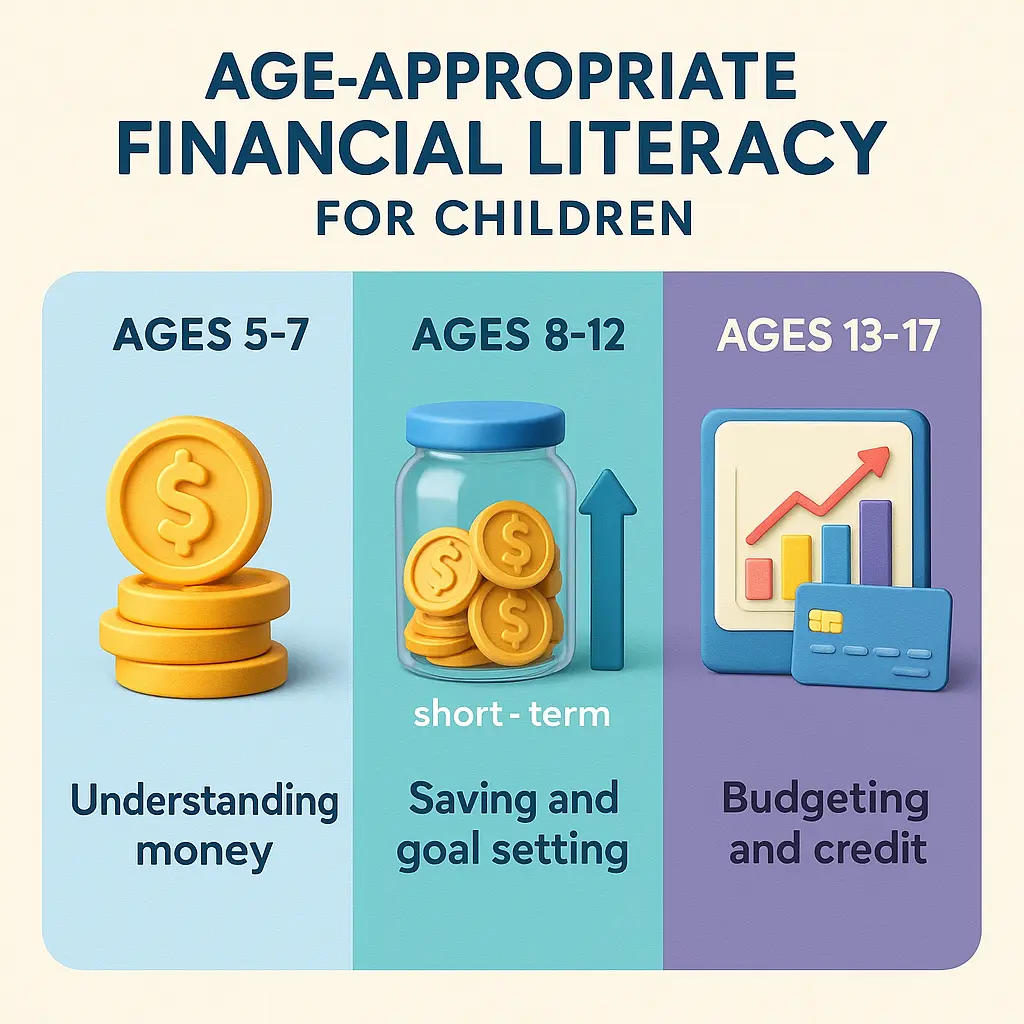
2. Understanding Age-Ready Financial Skills
Financial literacy for children is most effective when it aligns with their developmental stage. Just as corporate training programs are tailored to the skill levels and experience of employees, financial education should be structured around age-appropriate concepts and measurable outcomes. Introducing complex financial topics too early can overwhelm children, while delaying foundational skills may result in missed opportunities for habit formation.
By mapping financial skills to age and cognitive development, parents can create structured learning that builds progressively-from basic money recognition to strategic decision-making. This structured approach ensures that children not only understand financial concepts but also demonstrate observable behaviors that indicate comprehension and application.
Age-Appropriate Financial Skills and Measurable Outcomes
| Age Group | Core Financial Skills | Measurable Outcomes |
|---|---|---|
| 5–7 years | Understanding coins and notes, differentiating needs vs. wants, basic saving concepts | Can identify currency, save small amounts in jars, make simple spending decisions |
| 8–12 years | Budgeting with allowances, goal-setting, comparing prices, understanding basic trade-offs | Tracks spending, sets short-term goals, evaluates options before purchase |
| 13–17 years | Digital money management, compound interest basics, early investing concepts, responsible online transactions | Creates simple budgets, monitors digital spending, demonstrates understanding of saving vs. investing, plans for medium-term financial goals |
Key Principles for Structuring Age-Ready Financial Education
- Start simple, scale gradually: Introduce tangible, relatable concepts first (coins, allowances) before moving to abstract ideas like investment growth.
- Focus on measurable behaviors: Track savings amounts, budgeting accuracy, and goal completion to evaluate understanding, similar to KPIs in corporate training.
- Incorporate real-world practice: Encourage children to apply lessons through small, supervised financial decisions, enhancing skill retention and decision-making confidence.
- Leverage digital tools thoughtfully: Safe, age-appropriate platforms can reinforce learning and provide clear visual feedback, supporting the development of digital financial habits.
By structuring financial literacy for children in a staged, measurable way, parents can ensure that each phase builds a strong foundation for the next. Children who master these age-appropriate skills develop habits that compound over time, resulting in long-term financial discipline and strategic decision-making capabilities.
3. Teaching Through Allowances and Earned Money
One of the most effective ways to instill financial discipline in children is through structured allowances and earned money systems. Much like incentive-based programs in organizations, these approaches create accountability, measurable performance, and observable behavioral outcomes. When children receive money tied to responsibilities or goals, they learn the tangible value of effort, the importance of prioritization, and the consequences of financial decisions.
Structured allowances and earned money not only teach basic money management but also provide early exposure to budgeting, saving, and spending strategies. Children develop a sense of ownership over their finances, and parents can track progress and outcomes-mirroring how training management systems measure skill adoption and ROI.
Key Principles for Implementing Allowances and Earned Money
- Define clear expectations: Assign responsibilities or tasks tied to earning money. This creates accountability and reinforces the link between effort and reward.
- Encourage goal-oriented saving: Allocate portions of allowances for saving, spending, and sharing. This helps children practice financial planning and resource allocation.
- Monitor spending and decision-making: Review purchases with children to reinforce thoughtful financial behavior and evaluate the effectiveness of their choices.
- Introduce gradual complexity: Start with simple money management tasks and gradually introduce concepts such as budgeting for multiple goals, prioritizing needs versus wants, and understanding trade-offs.
- Measure behavioral outcomes: Track consistent saving habits, timely completion of tasks, and responsible spending. This provides tangible evidence of skill acquisition and mirrors KPI tracking in business training programs.
By integrating allowances and earned money into daily routines, parents can foster early financial literacy for children in a structured, measurable way. Over time, children internalize accountability, improve decision-making, and develop habits that contribute to long-term financial competence. The approach also delivers measurable “family ROI”-reduced impulsive spending, improved planning, and a foundation for strategic financial behavior in adulthood.
4. Goal-Based Budgeting for Children
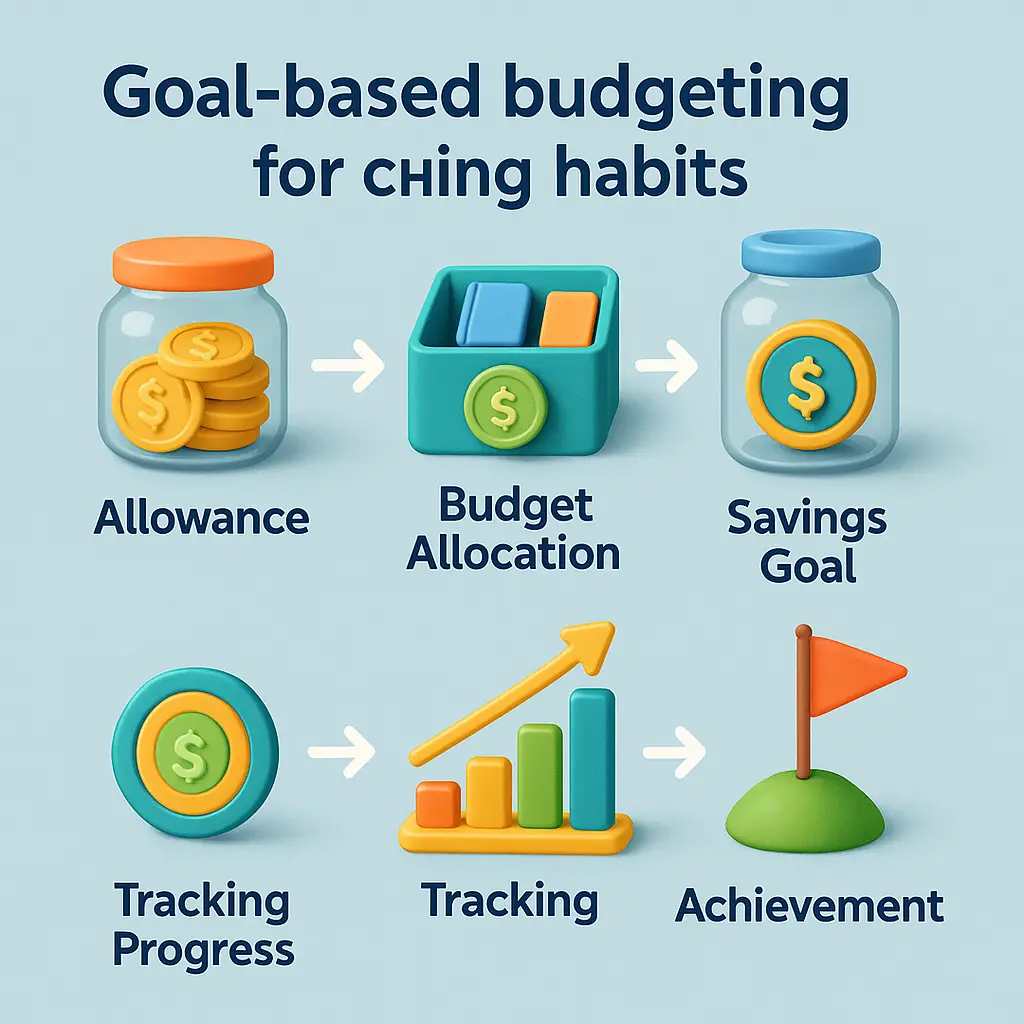
Goal-based budgeting is a critical pillar of financial literacy for children, providing a structured framework that teaches discipline, planning, and strategic decision-making. Much like performance-driven budgeting in business, this approach links resources to specific objectives, enabling measurable progress and reinforcing accountability. By learning to allocate money toward defined goals, children develop habits that enhance productivity, self-regulation, and long-term financial resilience.
Implementing goal-based budgeting helps children understand that every financial decision carries trade-offs. It also creates a tangible way to track progress, assess outcomes, and celebrate milestones-mirroring the way organizations measure ROI from training and skill development programs.
Key Steps to Implement Goal-Based Budgeting
- Define clear financial goals: Encourage children to set short-term and medium-term goals, such as saving for a toy, a book, or a small personal project. Goals provide direction and motivation.
- Allocate funds strategically: Teach children to divide their allowance or earned money into goal-specific categories, such as saving, spending, and giving. This reinforces prioritization and resource management.
- Track progress visually: Use charts, jars, or simple digital tools to help children see how their savings accumulate over time. Visual feedback strengthens motivation and accountability.
- Review and adjust regularly: Schedule weekly or monthly reviews to evaluate progress toward goals, discuss successes, and identify areas for improvement. This mirrors the iterative monitoring used in professional financial management systems.
- Celebrate milestones: Recognizing achievements-such as reaching a savings target-reinforces positive behavior and embeds the habit of structured financial planning.
By integrating goal-based budgeting into daily routines, parents can create measurable outcomes for financial literacy for children. Beyond the immediate ability to save and spend wisely, this approach develops self-discipline, reinforces consistent behavior, and cultivates a mindset oriented toward long-term productivity and financial growth. Children who practice goal-based budgeting consistently are more likely to approach future financial decisions analytically, strategically, and with confidence.
5. Building Digital Money Habits (Featuring My Wealth Locker)
In the modern world, digital money management is becoming an essential skill, even for children. Early exposure to safe, structured digital financial tools helps instill transparency, accountability, and measurable behavioral outcomes. Just as businesses leverage dashboards and analytics to monitor performance and ROI, parents can use digital platforms to track spending, savings, and goal achievement-reinforcing financial discipline in real time.
Financial literacy for children is enhanced when digital tools provide visibility into their money habits. Platforms that allow children to see their progress and make data-driven decisions promote a sense of ownership and strategic thinking. Beyond simple tracking, these tools teach children the principles of budgeting, goal setting, and delayed gratification in a practical, interactive manner.
Key Principles for Building Digital Money Habits
- Introduce supervised digital tools: Start with child-friendly apps that provide a clear overview of earnings, savings, and spending. This ensures safety while offering a practical learning experience.
- Visualize progress and goals: Dashboards and progress trackers give children a real-time view of how small contributions accumulate toward their objectives, reinforcing consistent financial behavior.
- Promote transparency and accountability: Digital records allow parents to review transactions and provide guidance, helping children understand cause-and-effect relationships in money management.
- Encourage data-driven decision-making: Children learn to evaluate spending choices based on current balances and goals, building analytical thinking similar to financial reporting in business.
- Leverage My Wealth Locker for real-world application: Tools like My Wealth Locker provide a secure, intuitive platform for children to track allowances, savings, and spending. By integrating gamified milestones and goal tracking, the app demonstrates the value of responsible digital money management and reinforces behavioral ROI over time.
By combining structured guidance with digital tools, parents can cultivate measurable financial skills and habits. Children who develop these competencies early not only gain confidence in managing money but also learn to make informed, strategic decisions. Integrating digital platforms like My Wealth Locker ensures financial literacy for children evolves from abstract concepts to actionable, trackable behaviors that yield long-term benefits.
6. Everyday Financial Lessons from Real-Life Transactions
Financial literacy for children becomes most effective when lessons are tied to real-world experiences. Just as employees learn practical skills through hands-on projects rather than theoretical training alone, children grasp financial concepts more quickly when they encounter them in everyday transactions. Whether it’s grocery shopping, paying for a bus ride, or managing a small online purchase, each interaction offers an opportunity to teach budgeting, value assessment, and responsible decision-making.
Integrating financial education into daily life creates measurable behavioral outcomes. Children begin to make conscious choices, compare options, and understand the consequences of spending, which mirrors the way businesses track ROI from skill-based training initiatives. Over time, these small experiences compound, fostering long-term financial discipline and strategic thinking.
Practical Ways to Teach Through Real-Life Transactions
- Value and price comparison: Encourage children to compare prices for similar products, teaching them to identify the best value and avoid impulsive decisions.
- Needs vs. wants analysis: Use daily purchases to discuss priorities, helping children differentiate between essential and discretionary spending.
- Opportunity cost understanding: Highlight what a child gives up when choosing one option over another, reinforcing the impact of trade-offs on financial outcomes.
- Simple decision-making frameworks: Guide children to evaluate choices based on budget limits, savings goals, and short-term priorities.
- Parental coaching and feedback: After each transaction, review decisions with the child to provide insights, reinforce positive behaviors, and correct misconceptions.
By embedding financial literacy for children into everyday experiences, parents can achieve tangible outcomes such as improved budgeting, enhanced decision-making, and early development of responsible spending habits. These small, consistent lessons act like micro-training modules, producing measurable skill growth, accountability, and long-term behavioral ROI-preparing children for larger financial responsibilities in adolescence and adulthood.
7. Encouraging Saving Discipline Through Visual Tracking
Developing disciplined saving habits is a cornerstone of financial literacy for children. Just as organizations track performance metrics to ensure accountability and productivity gains, visual tracking tools allow children to see tangible progress toward their financial goals. By transforming abstract concepts like saving and delayed gratification into concrete visual milestones, children learn to internalize good financial behaviors and measure their own success.
Visual tracking reinforces accountability, motivates consistent behavior, and demonstrates measurable progress over time. Children who can monitor their saving achievements are more likely to develop long-term financial discipline, much like employees whose performance is tracked and rewarded in structured workplace systems.
Key Strategies for Implementing Visual Tracking
- Use clear visual systems: Simple charts, jars, or progress bars help children see the accumulation of savings and the impact of consistent effort.
- Set measurable milestones: Break larger goals into smaller, achievable targets to maintain motivation and demonstrate incremental success.
- Integrate regular check-ins: Schedule weekly or monthly reviews to evaluate progress, discuss challenges, and adjust saving strategies.
- Reinforce positive behavior: Celebrate milestone achievements to strengthen habit formation and build intrinsic motivation for consistent saving.
- Leverage digital tools when appropriate: Platforms like My Wealth Locker can provide interactive dashboards that track savings, allowing children to visualize growth, analyze patterns, and refine their strategies.
By embedding visual tracking into financial learning routines, parents create a system that emphasizes both accountability and measurable outcomes. Children practicing these techniques not only reinforce their financial literacy for children but also cultivate discipline, goal-oriented thinking, and early strategic planning skills. Over time, these habits establish a foundation for financially responsible behavior that compounds into long-term wealth management capabilities.
8. Introducing Risk, Rewards, and Basic Investing
A critical aspect of financial literacy for children is understanding the relationship between risk and reward. Just as businesses evaluate investment opportunities with a balance of potential returns and associated risks, children can benefit from early exposure to these principles in a simplified, age-appropriate manner. Introducing concepts like saving, investing, and delayed gratification equips children with decision-making frameworks that foster long-term financial competence.
Teaching risk awareness and basic investing cultivates analytical thinking, encourages strategic planning, and demonstrates the compounding benefits of disciplined financial behavior. When approached thoughtfully, these lessons provide measurable behavioral ROI, helping children make more informed financial choices as they grow.
Key Principles for Teaching Risk and Investing
- Start with simple concepts: Explain basic ideas like saving for future rewards versus immediate spending, and illustrate how consistent saving can grow over time.
- Introduce low-risk investments: Use tangible examples such as savings accounts, bonds, or simulated investment games to teach basic investment mechanics safely.
- Highlight the trade-off between risk and reward: Encourage children to evaluate potential gains against possible losses, helping them develop critical thinking and prudent decision-making skills.
- Focus on long-term growth: Teach children that strategic decisions made today-like saving or investing small amounts regularly-can yield significant benefits in the future.
- Reinforce reflection and evaluation: After each simulated or small-scale investment, review outcomes to highlight lessons learned, reinforce good practices, and identify areas for improvement.
By integrating risk, rewards, and basic investing into early financial education, parents can provide measurable outcomes in decision-making ability, confidence, and strategic thinking. Children who understand these principles as part of their financial literacy for children curriculum are better prepared to navigate financial challenges, evaluate opportunities, and build long-term wealth responsibly. This approach mirrors professional financial management practices, demonstrating the compounding value of early, data-driven financial education.
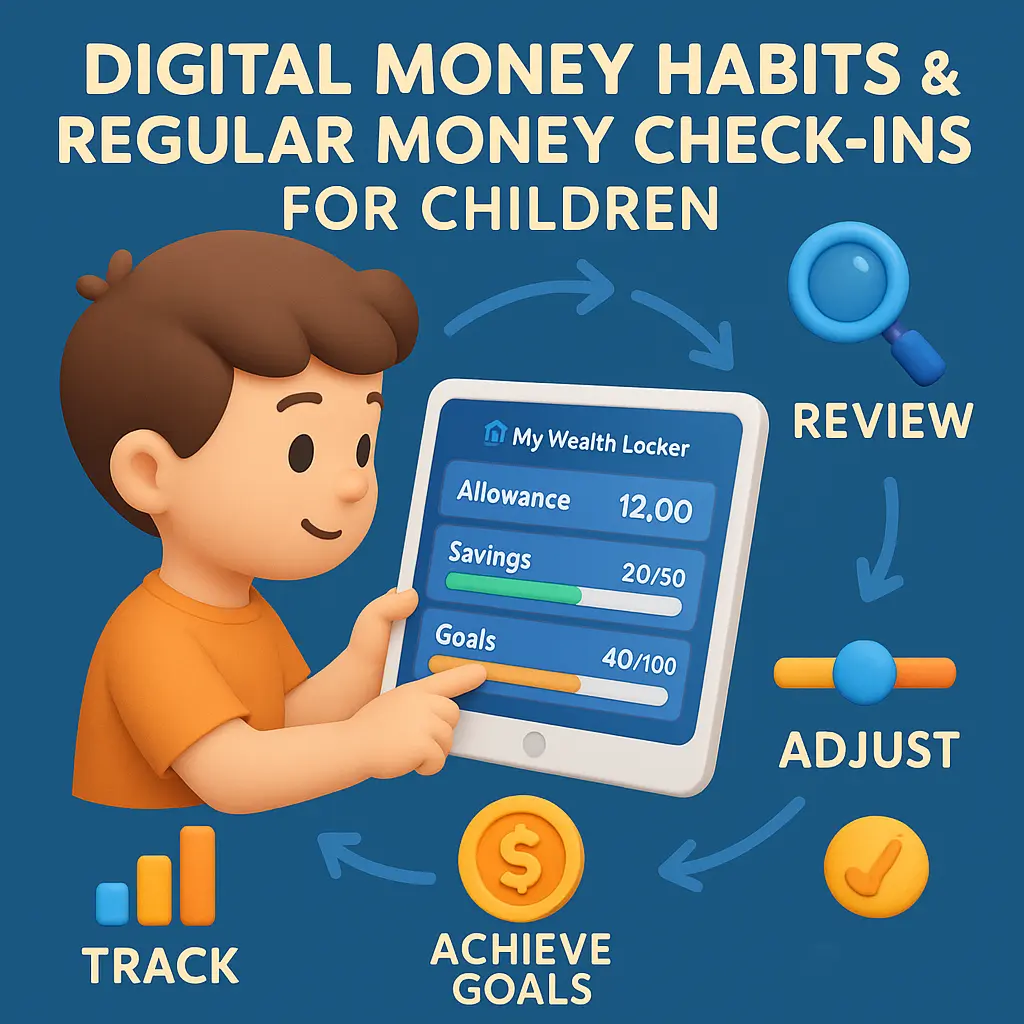
9. Establishing Regular Money Check-Ins (Supported by My Wealth Locker)
Consistent monitoring and review are critical for reinforcing financial literacy for children. Just as businesses implement structured review cycles to track progress, identify gaps, and improve performance, regular money check-ins provide children with a systematic approach to understanding their finances. These sessions encourage accountability, measurable progress, and the development of long-term financial discipline.
Regular check-ins allow children to reflect on spending, savings, and goals while providing parents an opportunity to offer guidance and feedback. Over time, this structured approach produces tangible behavioral improvements, helping children internalize strategic financial thinking and responsible decision-making.
Key Strategies for Effective Money Check-Ins
- Schedule consistent review sessions: Set weekly or monthly check-ins to evaluate spending habits, savings progress, and goal achievement. Consistency fosters accountability and builds structured routines.
- Track measurable outcomes: Review key metrics such as savings growth, percentage of goals achieved, and adherence to budgets to quantify progress.
- Encourage reflection and analysis: Ask children to explain their choices, lessons learned, and adjustments they plan to make. This promotes critical thinking and reinforces responsible financial behavior.
- Set new targets and challenges: Use check-ins to introduce new financial goals, update budgets, or adjust saving strategies based on previous results.
- Leverage My Wealth Locker as a structured tool: Platforms like My Wealth Locker provide real-time tracking, visual dashboards, and goal management, making review sessions more engaging, transparent, and measurable. Children can see progress, identify patterns, and make informed adjustments, reinforcing their understanding of financial literacy for children.
By embedding regular check-ins into the learning routine, parents create a measurable framework for accountability and progress. Children who participate in structured review cycles develop disciplined financial habits, improved goal management, and the ability to evaluate outcomes critically. Over time, this approach mirrors high-impact business review systems, producing sustained behavioral ROI and preparing children for long-term financial responsibility.
10. Conclusion
Investing in financial literacy for children is more than a practical lesson in managing money-it is a strategic initiative that yields measurable long-term returns for families. Just as organizations achieve compounding benefits by implementing structured training programs, parents who embed financial education into their children’s development cultivate skills that translate into lifelong decision-making efficiency, accountability, and wealth-building potential. Children who learn to budget, save, evaluate risk, and make informed financial choices early develop habits that compound over time, creating enduring value not only for themselves but for their entire household.
The generational advantage of early financial education lies in its ability to produce consistently responsible financial behavior. Children trained in these principles are more likely to become adults who make data-driven spending decisions, plan for long-term goals, and manage resources efficiently. Over time, these behaviors reduce financial stress, increase the household’s strategic flexibility, and enhance the family’s ability to achieve intergenerational wealth objectives.
Moreover, financial literacy for children fosters a mindset of continuous learning and disciplined planning. By establishing a foundation of measurable habits, goal-oriented saving, and thoughtful decision-making, parents equip their children with the skills to navigate complex financial landscapes confidently. This early investment mirrors high-ROI corporate strategies, where disciplined learning and tracking lead to sustainable performance gains. In essence, raising financially literate children is a proactive, strategic approach that delivers both immediate behavioral improvements and compounding benefits across a lifetime, creating a legacy of financial confidence and resilience for generations to come.