 admin
admin Master Your Money: Comparing the Best Budgeting Method for Your Financial Goals
Budgeting is one of the most powerful tools you can use to gain control over your finances, achieve your savings targets, and live within your means. But with so many strategies available, choosing the best budgeting method for your lifestyle can be overwhelming.
Two of the most popular approaches today are the 50/30/20 rule and zero-based budgeting. Each has its strengths and weaknesses, and the right method for you depends on your financial goals, spending habits, and how much structure you need.
In this comprehensive guide, we’ll help you understand both methods, compare them in detail, explore real-life use cases, and empower you to make the right choice for your personal budgeting journey.
Why Budgeting Matters More Than Ever
Before diving into the specifics of each method, let’s understand why budgeting is essential:
- Helps you track your monthly income and expenses
- Encourages disciplined saving and smart spending
- Prevents unnecessary debt
- Allows you to set and achieve clear financial goals
- Enhances your overall financial health and peace of mind
If you’re new to budgeting or looking to upgrade your current approach, finding the best budgeting method is a great starting point for building lasting financial discipline.
Method 1: The 50/30/20 Rule
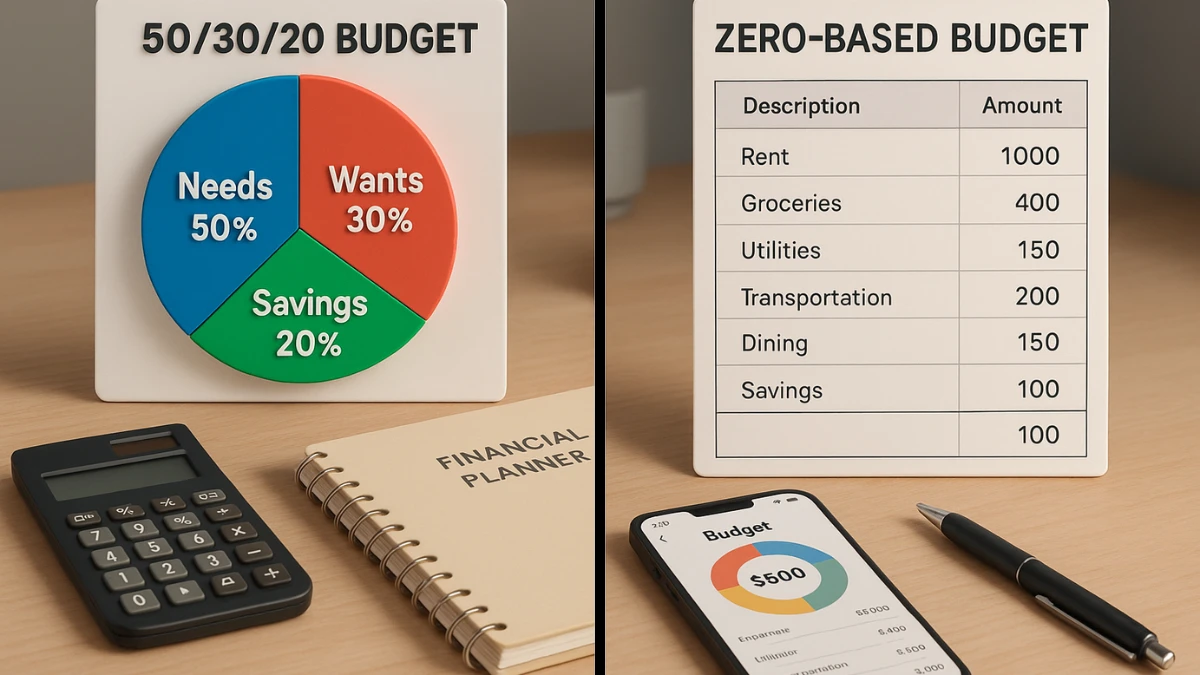
The 50/30/20 rule is a simplified budgeting framework that divides your after-tax income into three categories:
- 50% for Needs: Rent, groceries, transportation, utility bills
- 30% for Wants: Dining out, entertainment, subscriptions
- 20% for Savings & Debt Repayment: Emergency funds, investments, loan payments
Advantages of the 50/30/20 Budget
- Easy to implement and understand
- Encourages saving and spending plans simultaneously
- Provides flexibility while promoting financial discipline
- Ideal for beginners or those with a steady income
Drawbacks of the 50/30/20 Budget
- May not suit people with irregular incomes
- Doesn’t provide detailed tracking of all expenses
- Can be too broad for those with specific financial targets
If you’re wondering, “how to use the 50/30/20 rule effectively,” many budgeting apps like Mint and Spendee can automate the process for you.

Method 2: Zero-Based Budgeting
Zero-based budgeting requires you to allocate every single rupee of your income to a specific purpose until there’s “zero” left unassigned.
Example:
If your monthly income is ₹50,000, you must plan exactly how all ₹50,000 will be spent, saved, or invested — down to the last rupee.
Advantages of Zero-Based Budgeting
- Provides total control over cash flow management
- Encourages intentional spending and savings
- Excellent for people with variable incomes or debt payoff goals
- Great for detailed expense tracking
Drawbacks of Zero-Based Budgeting
- Time-consuming, especially if done manually
- Can be overwhelming for those new to budgeting
- Requires consistent effort and monthly reevaluation
Still asking yourself, “is zero-based budgeting better than 50/30/20?” Let’s dig deeper into comparisons.

50/30/20 vs Zero-Based Budgeting: Key Differences
| Feature | 50/30/20 Rule | Zero-Based Budgeting |
| Simplicity | High | Moderate |
| Flexibility | High | Moderate to Low |
| Detail | Low | High |
| Best For | Beginners | Detailed planners |
| Income Type | Regular | Irregular & variable |
| Expense Tracking | Broad categories | Line-by-line precision |
Which Budgeting Method Is Best for You?
This is the million-rupee question. The best budgeting method depends on your financial personality and situation. Let’s explore some real-world scenarios:
Scenario 1: A salaried employee with stable monthly income
If you receive a fixed paycheck each month, the 50/30/20 rule might be your perfect match. It’s easy to apply and gives you a broad overview of your spending.
Scenario 2: A family managing multiple expenses
For families juggling school fees, rent, groceries, and EMIs, zero-based budgeting offers better visibility and control over every rupee, making it the best budgeting method for families who want structure.
Scenario 3: A freelancer with fluctuating income
Since income varies month to month, zero-based budgeting helps allocate money based on what’s actually earned not projected income.
Scenario 4: Someone saving aggressively for big goals
If you’re targeting a home purchase, debt freedom, or an early retirement, zero-based budgeting lets you redirect more funds intentionally toward those goals.
Tips to Choose the Best Budgeting Method
Here are some practical guidelines to help you pick the best budgeting method:
- Evaluate your income type – Fixed or variable?
- Define clear financial goals – Short-term and long-term
- Consider your lifestyle – Are you detail-oriented or prefer simplicity?
- Try both methods for a trial period
- Use tools or templates for consistent tracking
- Combine strategies if needed – Hybrid models work too

Common Budgeting Mistakes to Avoid
Even if you’ve chosen the best budgeting method, here are mistakes that can undermine your efforts:
- Ignoring irregular or seasonal expenses
- Failing to track variable costs
- Not adjusting your budget monthly
- Setting unrealistic financial goals
- Budgeting without emergency savings
- Skipping reviews or updates
- Relying only on memory instead of apps or journals
Budgeting success isn’t just about choosing a method – it’s about sticking with it.
Can You Combine Both Budgeting Methods?
Yes – you absolutely can. In fact, many people find a hybrid approach to be the best budgeting method:
- Use 50/30/20 as a high-level guide
- Then apply zero-based budgeting for in-depth tracking within each category
This way, you enjoy flexibility while maintaining control.
Top Budgeting Tools to Help You Succeed
These apps support both budgeting styles and make it easier to choose your best budgeting method:
- Mint: Simplifies tracking with the 50/30/20 approach
- YNAB (You Need A Budget): Perfect for zero-based budgeting
- Goodbudget: Envelope-style digital budgeting
- Spendee: Beautiful data visuals + budget insights
About Wealth Locker: Your Smart Financial Partner
No matter which method you choose, consistency is key.My Wealth Locker helps users stay on track by:
- Categorizing expenses
- Recommending optimized saving strategies
- Offering visual reports for progress
- Syncing with your bank accounts
- Helping you pick and customize the best budgeting method
Join Wealth Locker to take control of your financial future – whether you’re starting fresh or scaling your wealth.
Final Thoughts: Find the Budgeting Method That Fits You
There’s no one-size-fits-all answer when it comes to the best budgeting method. Your financial situation, goals, personality, and lifestyle should guide your decision.
- Prefer simplicity and ease? Try the 50/30/20 rule
- Need detail and control? Opt for zero-based budgeting
- Like both? Use a hybrid model and get the best of both worlds
Whichever you choose, stick to it, review regularly, and use tools like Wealth Locker to automate and optimize your money management.
FAQs About Budgeting Methods
1. What is the best budgeting method for beginners?
The 50/30/20 rule is often considered the best budgeting method for beginners. It’s simple, efficient, and doesn’t require detailed tracking, making it a great entry point into personal budgeting.
2. Is zero-based budgeting better than 50/30/20?
It depends. Zero-based budgeting offers better expense tracking and control over every rupee. However, the 50/30/20 rule may be more practical for those who want a basic structure.
3. How do I choose the best budgeting method for my lifestyle?
Evaluate your monthly income, spending patterns, and time availability. If you want flexibility, go with the 50/30/20 rule. For structured planning, zero-based budgeting is the best budgeting method.
4. Can budgeting apps help implement both methods?
Yes! Most budgeting apps like YNAB and Mint support both methods. They simplify cash flow management and help you stay on top of your goals.
5. What’s the main difference between 50/30/20 and zero-based budgeting?
The difference between 50/30/20 and zero-based budgeting is that the former uses broad percentages, while the latter assigns every rupee a purpose. Choose the best budgeting method based on your need for detail.
6. Can I switch between budgeting methods?
Absolutely. It’s common to start with the 50/30/20 rule and later transition to zero-based budgeting. The best budgeting method evolves as your financial literacy and goals grow.